if,elif,else#
- 控制流:只在需要时才执行代码
- 靠缩进控制层级
if some_condition:
	# method1
	# method2
elif some_other_condition:
	#method3
	#method4
else:
	#method5
	#method6
#method7- 所有处于if下的==缩进==层级
method1,method2的代码,只有在条件some_condition为真时才会执行 - method7永远都会执行,而其他的则依据条件而论
>>> a=3;b=4;
>>> a
3
>>> b
4
>>> if a<b:
...     print('a<b')
... elif a==5:
...     print('a=5')
... else:
...     print('other')
... print('hello world')
...
a<b
hello world
>>> a=5;b=2;
>>> if a<b:
...     print('a<b')
... elif a==5:
...     print('a=5')
... else:
...     print('other')
... print('hello world')
...
a=5
hello world补充,一些快捷键:#
| 功能 | 快捷键 |
|---|---|
| 接受行内建议 | Ctrl + → |
| 传统补全列表 | Tab |
| 退缩进 | Ctrl + U(你的环境) |
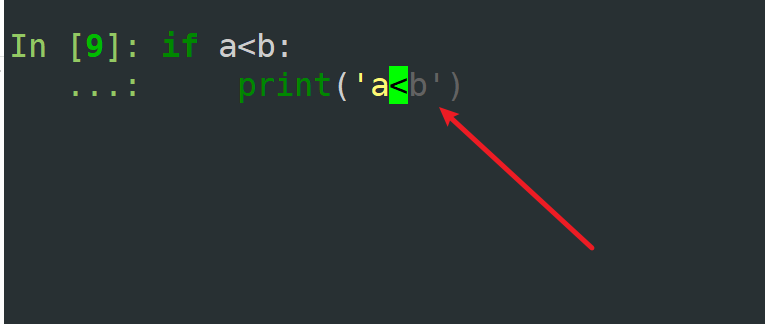
这种情况按ctrl+ -> 就会补全行内建议
例子#
>>> if True:
...     print('its true!')
...
its true!
>>> hungry = True
>>> if hungry:
...     print('feed me!')
...
feed me!
>>> hungry=False
>>> if hungry:
...     print('feed me!')
...
#if-elif
>>> hungry = False
>>> if hungry:
...     print('feed me!')
... else:
...     print('im not hungry')
...
im not hungryif-elif-else#
>>> loc='bank'
>>> if loc=='auto shop':
...     print('cars are cool!')
... elif loc == 'bank':
...     print("money is cool!")
... elif loc=='store':
...     print("welcome to the store!")
... else:
...     print('i do not know much.')
...
money is cool!

#另一个例子
>>> loc='game'
>>> if loc=='auto shop':
...     print('cars are cool!')
... elif loc == 'bank':
...     print("money is cool!")
... elif loc=='store':
...     print("welcome to the store!")
... else:
...     print('i do not know much.')
...
i do not know much.for#
- 对于可迭代
iterable的东西- 遍历列表中的元素
- 遍历字符串中的每个字符
print的定义:
print(*objects, sep=' ', end='\n' , file=None, flush=False)表示print可以接收多个对象,打印时对象之间以sep(默认为空格)字符串隔开,end表示结尾(默认是换行符)
#注意##之后就没有任何字符了,没有空格也没有换行符
>>> print('a','b','c',sep='xx',end='##')
axxbxxc##基本语法#
```shell
>>> my_iterable=[1,2,3]
>>> for item_name in my_iterable:
...     print(item_name)
...
1
2
3其他例子#
>>> mylist=[1,2,3,4,5,6,7,8,9,10]
>>> list=[]

>>> list
[]
#del 是 Python 的删除语句(delete statement),用于删除变量、对象里的元素等。
>>> del list
#这个是list真正的内置含义,是一个类,可以用来创建list
>>> list
<class 'list'>
>>> list('helo')
['h', 'e', 'l', 'o']
>>> mylist=[1,2,3,4,5,6,7,8,9,10]
>>> for num in mylist:
... print(num,end=',')
...
1,2,3,4,5,6,7,8,9,10,>>> for jelly in mylist:
... print(jelly,end=',')
...
1,2,3,4,5,6,7,8,9,10,>>> None
>>> for num in mylist:
... print('hello')
...
hello
hello
hello
hello
hello
hello
hello
hello
hello
hello和if结合#
>>> for num in mylist:
...     # check for even
...     if num%2 == 0:
...         print(num)
...     else:
...         print(f'oll Number: {num}')
...
oll Number: 1
2
oll Number: 3
4
oll Number: 5
6
oll Number: 7
8
oll Number: 9
10常用场景#
求和#
>>> mylist=[1,2,3,4,5,6,7,8,9,10]
>>> list_num=0
>>> for num in mylist:
...     list_num = list_num + num
... print(list_num)
...
55
#Python中,缩进是相当重要的东西
#下面的print语句,和list_sum=list_num+num在同一个代码块运行
>>> list_num=0
>>> for num in mylist:
...     list_num = list_num + num
...
...     print(list_num)
...
1
3
6
10
15
21
28
36
45
55

#注意下面的缩进问题,p要么和上面的list_num的'l'对齐,要么和for num的'f'对齐。否则都会报错
>>> for num in mylist:
...     list_num = list_num + num
...
...    print(list_num)
...
  File "<python-input-45>", line 4
    print(list_num)
                   ^
IndentationError: unindent does not match any outer indentation level #取消缩进后,没有匹配到任何已有的外层缩进层级。
>>> for num in mylist:
...     list_num = list_num + num
...
...      print(list_num)
...
  File "<python-input-50>", line 4
    print(list_num)
IndentationError: unexpected indent #Python 本来不期待这里有缩进,但是你加了。字符串#
>>> mystring='hello world'
>>> for letter in mystring:
...     print(letter,end=',')
... print()
...
h,e,l,l,o, ,w,o,r,l,d,
>>> for letter in "Hello":
...     print(letter,end=',')
... print()
...
H,e,l,l,o,
>>> for le23tter in "Hello":
...     print(le23tter,end=',')
... print()
...
H,e,l,l,o,
#_ 就是一个普通变量名。不过当你不关心变量时才会用

#不常用
>>> for _ in "Hello":
...     print(_,end=',')
... print()
...
H,e,l,l,o,

#常用
>>> for _ in "Hello":
...     print('abc',end=',')
... print()
...
abc,abc,abc,abc,abc,

#不论要遍历的对象是啥,没有特殊处理的情况下,永远只遍历外层的对象(这个是元组)的元素个数次数
>>> for item in (1,2,['t','e'],'a',(5,6)):
...     print(item)
...
1
2
['t', 'e']
a
(5, 6)元组解包#
tuple unpacking
mylist=[(1,2),(3,4),(5,6),(7,8)]
>>> for item in mylist:
...     print(item)
...
(1, 2)
(3, 4)
(5, 6)
(7, 8)
#用变量单独访问元组单个的项
>>> for (a,b) in mylist:
...     print(f'{a}xx{b}')
...
1xx2
3xx4
5xx6
7xx8
#省略左括号和右括号
>>> for a,b in mylist:
...     print(f'{a}xx{b}')
...
1xx2
3xx4
5xx6
7xx8


>>> mylist=[(1,2,3),(5,6,7),(8,9,10)]
>>> for a,b,c in mylist:
...     print(f'a={a},b={b},c={c}')
...
a=1,b=2,c=3
a=5,b=6,c=7
a=8,b=9,c=10字典-迭代解包#
默认字典是无序的,下面只是看起来好像有序
#默认情况下只遍历键
>>> for a in {'name':'kankan','age':12}:
...     print(a)
...
name
age
#只遍历值
>>> for a in {'name':'kankan','age':12}.values():
...     print(a)
...
kankan
12
#遍历项
>>> for item in {'name':'kankan','age':12}.items():
...     print(item)
...
('name', 'kankan')
('age', 12)
#解包
>>> for a,b in {'name':'kankan','age':12}.items():
...     print(f'{a}xx{b}')
...
namexxkankan
agexx12while#
while:
>>> i=0
>>> while i<10:
...     print(i,end=',')
...     i+=1
...
0,1,2,3,4,5,6,7,8,9,>>> i
10
while-else:
>>> i=0;
>>> while i<4:
...     print(i)
...     i+=1
... else:
...     print(f'end--i={i}')
...
0
1
2
3
end--i=4
#while和else不是顺序关系,更像是while里面嵌套了 if-else ,然后else隐藏了break,类似
i=0
while(True):
	if(i<4):
		print(i)
		i+=1
	else:
		print(f'end--i={i}')
		break

#下面这个会直接打印end--i=50并退出
>>> i=50
>>> while(True):
...     if(i<4):
...             print(i)
...             i+=1
...     else:
...             print(f'end--i={i}')
...             break
...
end--i=50
#while-else一样的结果
>>> i=50
>>> while i<4:
...     print(i)
...     i+=1
... else:
...     print(f'end--i={i}')
...
...
end--i=50
附(模拟do-while):
>>> while True:
...     value = input("请输入:")
...
...     if value == "quit":
...         break
...
请输入:2
请输入:3
请输入:quitbreak,continue,pass#
- pass相当于什么都不做
- 占位语法,空操作(no-op,no operation)
>>> x = [1,2,3]
>>> for item in x:
...     # comment
...     print('ha')
...     pass
...     print('b')
... print('end of my script')
...
ha
b
ha
b
ha
b
end of my script
continue: 跳过当前循环的余下部分,继续下一次迭代
>>> for item in x:
...     # comment
...     print('ha')
...     continue
...     print('b')
... print('end of my script')
...
ha
ha
ha
end of my script
break: 跳出该层循环体 外层的迭代继续
>>> for item in x:
...     for _ in [1,2]:
...          # comment
...          print('ha')
...          break
...          print('b')
... print('end of my script')
...
ha
ha
ha
end of my script
whiel中使用break:
>>> while x<5:
...     if x == 2:
...         break #遍历到2就跳出whle循环
...     print(x)
...     x+=1
...
0
1